 By Tina Brown
Data quality measures how reliable, accurate, and fit for purpose a dataset is for its use in decision-making and reporting.

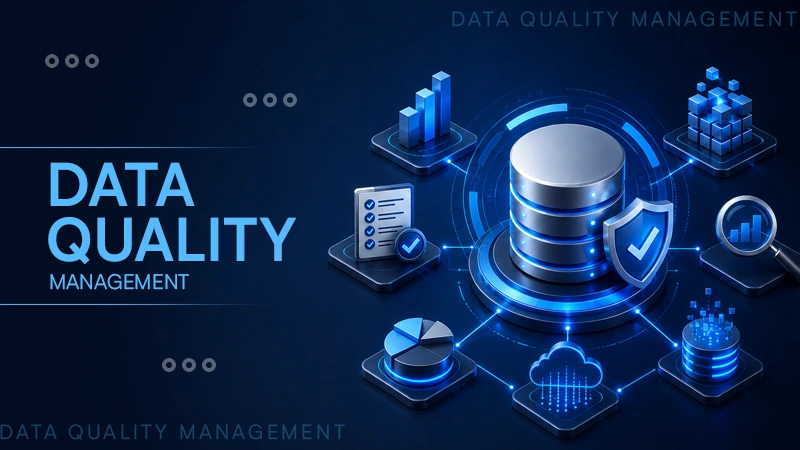
Nowadays, every business heavily depends on data generated by users. One of the core models for any business is to leverage data for enhanced data-driven decision-making. To implement this, data quality management practices are needed.
If the data is of poor quality, it may cause incomplete or incorrect analysis. That can become a serious issue for any business.
That is where data quality management comes in. It is the process of maintaining accurate and reliable data throughout its lifecycle.
Hence, understanding it has become indispensable for businesses looking to fully utilize their data.
Let’s learn more about it.
If one has to convey the definition of data quality in simple terms, we can say that it measures how reliable, accurate, and fit for purpose a dataset is for its use in decision-making and reporting.
High-quality data is foundational for any business in customer service, forecasting, analytics, and automation.

The Six Dimensions model is a proven tool for understanding the various aspects of data quality. Have a look at the characteristics.
Note: It is possible that the data in the analytics platform may not conform to all six dimensions. However, as it moves through the system, it should be cleaned and transformed.

Data quality management (DQM) is the continuous practice of measuring, monitoring, and improving the data in any organization.
The goal of this practice or process is to ensure that the information is accurate, consistent, complete, and reliable. So, the data remains available for analytics and everyday business operations.
DQM is not a one-time task but a sustained lifecycle.
The sustained lifecycle of DQM involves the following:
Before the improvement, we must understand what is needed. Data profiling examines a dataset to understand its structure, reveal patterns, and detect issues like missing values, inconsistencies, and errors.
In this process, the data is cleansed or cleaned. It means the errors or inconsistencies in raw datasets are removed.
There are a few methods to achieve that; here is the list.
The process of verifying the data is called data validation. The process checks if the data is clean, accurate, and in line with the rules and requirements for quality.
As we’ve stated earlier, ensuring data quality is an ongoing process. So, this step of the process utilizes automated tools and real-time alerts to make sure that data integrity is not compromised.
Now, we’ve come to the data governance step of this lifecycle. This step enforces policies, defines roles, and ensures accountability.

To understand the importance of DQM, one must look at what happens when it is not in use.
For a data-driven business, poor data quality can result in delays, errors, financial losses, and more.
Let’s look at some pointers on why DQM is important for businesses.
Now, let’s look at data quality assurance. In simple terms, we can say that it focuses on preventing data errors even before they occur, rather than correcting them afterwards.
Standards, validation, monitoring, and regular reviews are implemented to make sure it stays up-to-date.
Now, we’ve come to the crux of the matter. How does one perform DQM?
Most organizations use custom data quality software designed specifically for profiling, cleansing, validation, and monitoring. These tools allow businesses to automate all efforts without engaging in manual processes.
A trusted consultant provides strategies to help you achieve long-term objectives. These include assessing the current data maturity level, defining business-relevant data governance standards, and performing continuous monitoring.
Just investing in DQM doesn’t mean it will remove all issues; it is mostly about unlocking data potential.
Here are a few benefits of effective DQM.
The need for data has increased in the modern world. Amid this rising demand, DQM has become an important process for businesses to make sense of their data.
It ensures that data present in systems serves the ultimate purpose. Let’s check out some of the best practices for maintaining high-quality data.
Growing businesses choose Dataqix for the advantages of the data quality management services it offers. Check out the following table to learn more about why Dataqix is a great choice for management.
| Feature | Other Data Quality Solutions | Dataqix |
| Cost | Higher licensing and implementation costs | Flexible pricing tailored to business needs |
| Accuracy | Varies based on configuration and manual intervention | AI-powered validation for highly accurate, reliable data |
| Scalability | Scaling may require additional infrastructure or licenses. | Easily scales with growing data volumes and business requirements |
| Security | Standard security features, depending on the provider | Enterprise-grade security with robust data protection |
| Technology | Automation features vary across platforms. | Built-in AI, automation, and advanced data quality capabilities |
| Turnaround | Data quality tasks may require manual reviews. | Faster processing through automated profiling, validation, and cleansing |
If you are a business and looking for a consultation, head over to the Dataqix – Contact Us page and reach out.
Data quality measures how reliable, accurate, and fit for purpose a dataset is for its use in decision-making and reporting.
Data quality management is the process of improving, monitoring, and maintaining data throughout its lifecycle.
Because it can improve decision-making, increase operational efficiency, and support regulatory compliance.
Data quality assurance focuses on preventing data errors even before they occur, rather than correcting them afterwards.
Data quality software is designed specifically for profiling, cleansing, validation, and monitoring. It can easily automate such tasks.
Sources:
Nowadays, every business heavily depends on data generated by users. One of the core models for any business is to…
July 27, 2026
While considering data entry outsourcing costs, there are various things that one has to pay attention to. Most importantly, one…
July 14, 2026
The benefits of outsourcing data entry are varied and promising. Specifically, outsourcing helps save key costs and reduce internal workload.…
July 10, 2026
Every growing business needs accurate data to make fast decisions. Choosing the right data entry outsourcing company helps you reach…
July 3, 2026 By Jim Hartman