 By Jim Hartman
To explain it in simple terms, we can say that data lakes are storage repositories that can ingest large amounts of structured, unstructured, or semi-structured data in its raw format.

A data lake is a storage repository specifically designed to store large amounts of structured, semi-structured, and unstructured data in its native, raw format.
It has emerged as a reservoir where raw data can freely reside in its natural state. That offers unmatched flexibility and scalability.
In the future, data needs are going to evolve, and that is why the need for data lakes is going to increase as well. In this guide, we’ll talk about “what is a data lake” and everything there is to know about data lakes.
Let’s begin with the basics.
A data lake is a repository that stores large volumes of data in its original form.
It is highly scalable and allows all data types. Meaning, organizations can use data as is without cleaning, transforming, or structuring. Since it has an open and scalable architecture, it can accommodate all types of data from any source.
These days, data lakes are a core component of many organizations’ data architectures. Generally speaking, they are used as a low-cost, general-purpose storage measure for old or unused data.
Typically, it includes a holding area for incoming data or for storing massive unstructured datasets required for AI, ML, and data science.
In the modern world, many applications need copious amounts of data, and the storage requirements for that are also taxing for companies.
For that exact reason, they utilize a data lake to store a huge amount of raw, unstructured, and semi-structured data in its native format.
It breaks down data silos, cuts storage costs, and gives companies the foundation for setting up advanced analytics, ML, and AI. That too, without requiring upfront data formatting.
Have a look at some of the reasons why organizations may need a data lake.
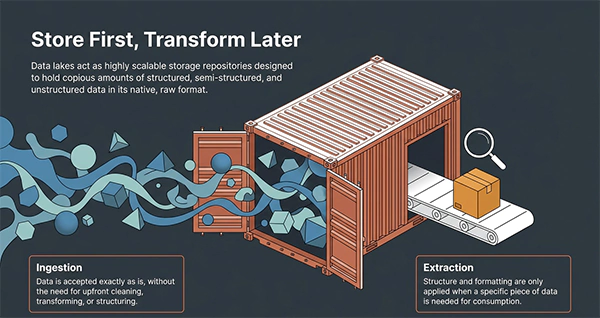
We’ve explained earlier what a data lake is; now it’s time to learn how it works.
You must know that it works on a “store first, transform later” model using the schema-on-read principle. That is what makes it highly scalable and flexible for big data analytics, ML, and AI.
You may be wondering what the schema-on-read principle. Well, no worries, we’ll explain.
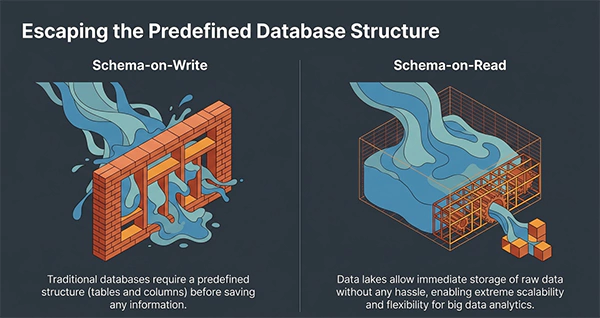
As you may guess from the naming, schema-on-read allows for immediate storage of raw and unstructured data. On the other hand, schema-on-write requires a predefined database structure (tables and columns) before saving anything to the database.
Working on the schema-on-read principle, a data lake allows for structured, unstructured, and semi-structured data to be stored immediately without any hassle.
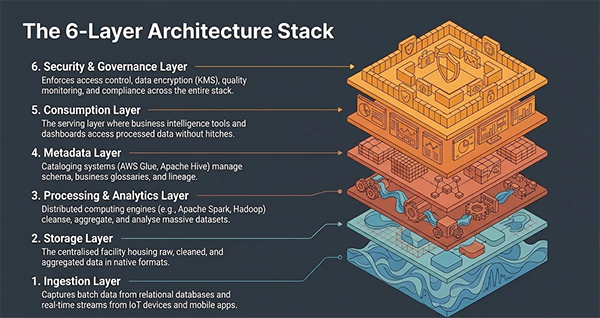
Well, the data lake architecture is divided into logical layers and technical components. Hence, ensuring that the data coming into the system doesn’t devolve into a chaotic data swamp.
Let’s look at various architectural layers.
Note: Without proper governance through each layer, it could turn into a data swamp. Where finding anything would be impossible for the system.
Since everything is online nowadays, all the companies in the world require the help of data lakes to satiate their needs.
Some major companies such as Netflix, Uber, and Nestle use cloud data lakes to store petabytes of raw and unrefined data.
Here are some examples of real-world data lakes.
All these are high-level systems designed to store data for later use. But they work differently and are suited for different requirements.
For example, a data warehouse stores structured data that is readily available for fast reporting. On the other hand, a data lake stores massive volumes of raw and unstructured data.
A data lakehouse is something different; it is a combination of both worlds. Think of it as a low-cost storage solution that comes with structure and management.
| Data lake | Data warehouse | Data lakehouse | |
| Type | All types – Structured, semi-structured, unstructured | Structured | All types – Structured, semi-structured, unstructured |
| Relational, non-relational | Relational | Relational, non-relational | |
| Schema | Schema-on-read | Schema on write | Both schema-on-read and schema-on-write |
| Format | Raw, unfiltered | Processed, vetted | Raw, unfiltered, processed, curated, delta-format files |
| Sources | Big data, IoT, social media, streaming data | Application, business, transactional data, batch reporting | Big data, IoT, social media, streaming data, application, business, transactional data, batch reporting |
| Scalability | Easy to scale at a low cost | Difficult and expensive to scale | Easy to scale at a low cost |
| Users | Data scientists, data engineers | Data warehouse professionals, business analysts | Business analysts, data engineers, data scientists |
| Use cases | Machine learning, predictive analytics, real-time analytics, IoT | Financial reporting, BI, analytics | Core reporting, BI, machine learning, predictive analytics |
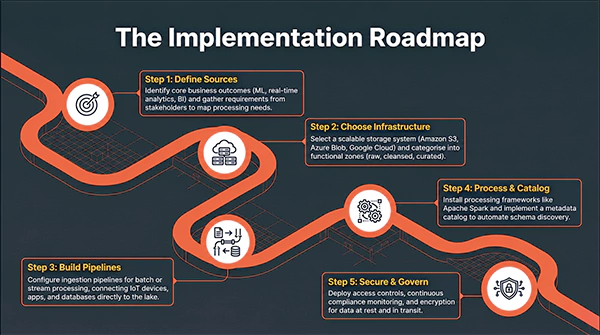
To build a data lake, one has to implement several key steps. These steps contribute to building a scalable, flexible, and efficient system that can manage and analyze copious amounts of data.
Here is the five-step overview of building a data lake.
Step 1: Define Data Sources
Step 2: Choose Your Storage Infrastructure
Step 3: Build Data Ingestion Pipelines
Step 4: Process and Catalog Data
Step 5: Secure and Govern the Data Lake
Below are the benefits of data lakes.
Yes, the benefits of this can make them a compelling investment. However, you also need to consider the challenges and risks associated with it.
Also Read: What is Data Processing?
A data lake is a storage repository that can store large amounts of data in a raw format, without alteration. It operates on a “store first, transform later” model using the schema-on-read principle.
It offers various benefits to companies looking for a cost-effective solution for storing data where real-time access is not required. With this solution, they are able to realize the full potential of their data and create business benefits.
Also Read: What Is Data Extraction?
To explain it in simple terms, we can say that data lakes are storage repositories that can ingest large amounts of structured, unstructured, or semi-structured data in its raw format.
A streaming platform like Netflix is a perfect example of a data lake. It stores user interactions, clickstream data, and movie recommendations.
The key difference between a data lake and a data warehouse is that a data lake can accept unstructured, structured, and semi-structured data, while the warehouse can only accept structured data.
Big tech companies like Netflix, Uber, Google, etc., use data lakes to store different kinds of data.
Sources:
AI and machine learning have stepped out of laboratories to be used in a multitude of everyday products. Some of…
September 14, 2026
When you see the padlock icon on your computer or visit a secure website, something immediately clicks within the invisible…
August 27, 2026
Markdown is a type of lightweight markup language that is used to represent plain text in a structured way. It…
August 21, 2026
Retrieval-Augmented Generation (RAG) is an AI framework that connects LLMs to external data sources so they can give accurate and…
August 3, 2026
A data lake is a storage repository specifically designed to store large amounts of structured, semi-structured, and unstructured data in…
July 30, 2026
Every second, businesses generate massive amounts of data through customer interaction, SaaS applications, and cloud platforms. Collecting this data is…
July 27, 2026 By Tina Brown