 By Jim Hartman
In general, primary research refers to information you gather for your purposes without using any already existing data sources. Secondary research relies on previously collected data.

Primary vs secondary research comes down to one question: did you collect the data yourself for this study, or are you reusing data someone else collected? Teams often either spend too much time and money gathering new data, or rely on existing data without checking whether it fits. Understanding the difference between primary and secondary research helps you avoid both mistakes. Primary research directly provides new data from the source, while secondary research relies on data collected by someone else. Each type of research has its benefits and limitations.
In this article, we will define primary vs. secondary research, highlight their differences, explain how to choose the right method according to the goals, and show how co-use of both types can improve research results. Dataqix has 5 years of experience in the field of data processing and knows how important it is to translate trustworthy data into useful information.
The concept of primary research and secondary research covers two types of data collection processes for making decisions. Primary research involves the collection of original data for a specific study, whereas secondary research involves the collection of data that was initially collected for a different purpose. The most significant difference between primary and secondary research lies in the relation of the data to the research question, irrespective of whether the data is collected inside the organization or from outside. For instance, a survey conducted among the customers inside the company aimed at conducting a new project is an example of primary research, whereas an existing company report that is reused for the same project becomes a piece of secondary research.
Primary data refers to the data that is obtained first-hand from the source for answering a particular research question. It is collected for the purpose of the study and provides data that can be tailored according to the researcher’s objectives.
In other words, original data is information that you have gathered rather than information you have borrowed from previously published reports.
For example, if an organization intends to learn why certain people abandon the onboarding process, it may conduct a survey users who started onboarding but did not complete it
There are several methods of collecting original data used by researchers according to the target audience and objectives of the project.
Surveys:
Surveys are a method that helps collect data for analyzing satisfaction levels or other parameters of interest.
Interviews:
Conduct one-on-one interviews to find out insights on personal experiences faced by people, their reasons, and the troubles endured. Interviews are important when extensive stories are needed rather than quantitative data.
Observation:
Assess how individuals behave in practice or experiments. For example, observing a user navigating a website gives clues about the website’s usability, which may not be provided in surveys.
Focus groups:
Gather a limited number of people to discuss a product or service. Group discussion helps gather information about the thoughts and feelings of individuals.
Experiments:
Test the influence of a variable modification on an outcome. For example, a company tests two landing page designs to see which one of them gets more subscriptions.
Ultimately, the choice of a method should depend on the question. Surveys and experiments provide quantifiable results, while interviews and focus groups give in-depth understanding of the subject under research.
Example 1: A survey given to customers on a new onboarding feature
A company now includes a new onboarding feature and is unsure of whether or not it will help customers understand the product. The firm decides to send out a questionnaire to users who have just finished onboarding. The customers will answer questions that relate to clarity, ease of use, and satisfaction. As such, the data collected is primary data, since the information obtained was for evaluating its newest feature.
Example 2: Discussions with students about barriers to learning
The training provider suspects that some course participants are not able to learn effectively. As a result, researchers conduct interviews with trainees to detect the problems they face. Examples of problems faced may include lack of time, unclear instructions, or lack of access to learning materials. Since the information obtained is related to the study that the training provider is currently conducting, the students’ responses are considered primary data.
In each situation, the data is gathered to answer that specific question. In both instances, the data collection is done with a goal in mind rather than using the existing information as the basis.
Pros:
Complete authority over designing and executing the data collection process, an exact answer to the question posed, useful up-to-date information, and some information that is not present in the competitor’s research.
Cons
Requires time and money, can cause respondent fatigue, and depends heavily on question quality. Poorly worded questions or a biased sample weaken the study’s validity.
Secondary data is information collected for a different purpose and later reused to answer a new research question. What matters is how the data relates to your current question, not who collected it. For example, a customer survey your company ran last year is primary data for that original study. If your team reuses the same responses to study customer loyalty, it becomes secondary data, even though your company collected it.
Internal secondary data
Internal secondary data is information your business already holds, such as CRM records, sales reports, and past surveys. Check that it is still current, because customer needs and market conditions may have changed.
External secondary data
External secondary data comes from outside your organization, such as government agencies, industry reports, and academic journals. Businesses use it to understand market trends, demographics, and consumer behavior.
Secondary data can be internal or external. Here is one example of each.
Example 1: Internal: last year’s customer feedback survey
The company conducted a study of the business’s customers’ satisfaction last year. Now the marketing specialist wants to study the phenomenon of customer loyalty. Instead of carrying out another survey of that kind, the marketing employees can analyze the existing responses to the previous studies and check whether there are any helpful pieces of information in the responses they have collected.
Example 2:External: census statistics
A medical provider thinks about establishing a new clinic. The research group checks the official demographic data to understand the size of the patient pool. The data helps the medical provider to evaluate potential demand without getting new statistics.
The census statistics were collected for a wide statistical problem but are employed now to support a specific business decision.
Pros
Easy to obtain, usually cheaper than new data collection, and offers historical depth and scale that new data collection can’t match.
Cons
Definitions used may not coincide with yours, coverage may exclude your specific region or audience, and the data was gathered for a different issue. Always check the source and the time when the data was obtained and the methodology used.
It is necessary to recognize the difference between primary and secondary data, which allows researchers to choose the right method to suit their objectives, budget, and timeline. Primary data is collected specifically for the existing problem, but on the other hand, secondary data makes use of already existing information. It means that both methods can be used for effective decision-making, but they differ in the way they treat information gathered for the goal, in the level of control research can have over the process, as well as in the limitations.
| Factor | Primary Research | Secondary Research |
| Data Source | Collected by you or on your behalf | Collected by others |
| Compatibility | High: designed specifically for the research question | Varies, repurposed |
| Cost | High | Lower, or even free |
| Speed | Slow: weeks to months | Fast: hours to days |
| Control over quality | Full control over quality | Limited by source verification |
| Data freshness | Current | Potentially outdated |
| Amount of Data | Limited by the budget constraints | Can have large and long history of the data |
| Ownership of the data | Proprietary | Available to competitors |
| Applications | Specific, innovative, and niche issues | Market sizing, benchmarking, background research |
Myth: primary is always expensive and reliable, while secondary is always cheap and untrustworthy.
This is not the case, however: a small, poorly planned survey can be an expensive disaster, while a properly executed national statistics release may provide more reliable data than anything a single team can gather. Cost also varies, and the speed of data collection can impact the price considerably. When establishing the quality of the data collected, the method of collecting the data, the definitions used, etc., should be taken into account.
Making a decision regarding primary research or secondary research really depends on your information needs, the information already available, and the promptness of your findings. The key aspect of the research is not the amount of data you can get but rather finding proof for your research question.
Here’s how to choose primary research vs secondary research:
Use primary research when you cannot find existing sources that talk about the specific audience, metrics, or time of the situation. For example, if you want to know why your customers are leaving you, there is no report that can answer your question. Primary research is also the better choice when existing data is outdated, when you’re making a high-stakes pricing or advertising decision, or when you need insights competitors can’t access.
Use secondary research if the answer is out there. It is the right option for market sizing, observing long-term trends, evaluating industry benchmarks, and the first stage of research on what is known. It is the most practical option if there are constraints in terms of time, money, or if the answer exists from another credible source already.
The following yes/no questions are to determine if it’s necessary to conduct primary research, secondary research, or a combination of both.
Is there relevant and reliable data available on the question?
If
Yes: Then the evaluation of the existing data needs to be done.
No: Then primary research needs to be conducted.
Is the existing data relevant in terms of population, variables, and timeline?
Yes: This may be enough.
No: New data need to be collected, or existing data needs to be combined with relevant research.
Is the current feedback needed, or do you require answers to previously unasked questions?
Yes: Primary research needs to be done.
No: Existing information can be utilized.
Are you looking for trends over time, market references, or a broader background?
Yes: Start with secondary data.
No: Concentrate on material that relates closely to your objectives.
Will combining existing data with novel research lead to a better outcome?
Yes: Use both approaches.
No: Enable the technique that yields the best, most credible data with minimum effort.
Important: Find out where you can get ready data before starting new data collection. Searching for an hour is worth saving many weeks of fieldwork; even when utilizing primary data, previous data will improve your inquiries.
Before using primary or secondary data, you should find out if the resource can help achieve your objectives. For instance, even if a reliable organization has gathered an impressive data set, your results can be erroneous if the data was gathered from the wrong group of people, the definitions were inconsistent, or some data is missing.
An appropriate data source is that which fits research criteria and can help achieve your final objectives.
There is no need for a source to be perfect for it to be important. Before starting analysis, all limitations must be recognized, noted down, and worked upon.
The validity of internal data has to be handled thoroughly as well as external data. The fact that your own internal data was produced by your own people gives you false confidence in its credibility. In reality, however, various internal documents, such as CRM reports, surveys, and service records, often suffer from duplicates, altered definitions, and missing information. When using such data for an analytical purpose, its background must be confirmed like in any source.
At Dataqix, we begin data processing by cleaning and validating the raw data. Several data processing techniques are available that allow us to determine if a source can be used. Validation and data cleansing procedures are designed to achieve that. The following steps must be undertaken to make the source usable before the analysis begins.
Accuracy checks: Ensure that the values meet certain rules, match with reliable sources and are in acceptable ranges.
Duplicate detection: Detect any duplicates that may lead to inflated counts, transaction total and customer count. Determine if the duplicate records are actual duplicates or not prior to removing them.
Missing-field analysis: Identify missing fields or information, quantify the extent of missing data, and evaluate any possible bias it introduces.
Consistency checks: Make sure that date format, unit, categories and names are standardized to enable data comparison.
Structural validation: Ensure the right structure of data types, columns, identifiers and relationships.
For example, if a company wants to examine client retention based on historical CRM data extracts, it must check consistent client IDs, duplicate handling, the availability of relevant dates, and the correct interpretation of active clients.
It is in the combination of data sources that primary and secondary research really pays off, but it is also where mistakes can happen. Some planning beforehand ensures that you get it right.
Be clear on the purpose of each source before combining them.
Make clear what the aim of each data source is. One useful division is:
When you know that each source has its own purpose and objective, you will not accumulate information unnecessarily.
Let us take the example of a provider of training that wishes to know if its night-time courses are useful for students.
The provider will connect the figures from attendance and responses to the questionnaire, as well as compare them with regional statistics. The findings can show that the number of employed respondents among the students is 62% against 55% in the region.
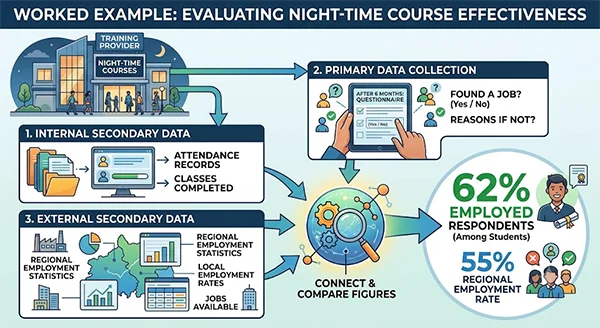
Note that this compares only graduates who responded with the whole region, so non-respondents and non-finishers are missing, which can skew the result.
Myth: combined data proves causation
Reality: it describes outcomes but cannot prove cause.
Using multiple sources allows you to describe outcomes better, but it does not provide evidence of causality. For instance, in the above-mentioned example, learners who completed the course could have been more motivated and really able to find a job. Use the combined results to inform your decisions, leaving causality claims to controlled comparison or experiment.
Whatever the type of data used – newly collected survey data or already available business data sets- data quality is a must for credible research. Dataqix makes sure the data goes through data entry, data-cleaning, validation, and structuring to ensure its consistency and readiness for analysis.
AI and RPA tools speed up repetitive, high-volume data processing, while human validation checks keep the output accurate and catch duplicates and missing values.
These services allow companies to take less time to handle raw data to help them in decision-making when preparing primary research information and accomplishing secondary datasets.
If you require assistance with your research data, please call Dataqix for a quote or for free samples and consultations regarding your needs in data treatment.
In general, primary research refers to information you gather for your purposes without using any already existing data sources. Secondary research relies on previously collected data.
It depends on how we are going to use it. If we are using the survey for its initial purpose, it serves as primary data. If we exploit it later to answer other questions, it becomes secondary, although our company is the source of this information.
The answer is no. Accuracy varies based on how the data was gathered and assessed instead of its classification. In fact, a poorly structured survey can be less reliable than a properly conducted national statistics report. Make sure to check the sample, definitions, method, and date of any source.
Yes, primary data can include qualitative information like video transcripts and data collected via interviews. Secondary data can also include the same information, like unprocessed social media posts or peer reviews from research articles. Both types of data can have quantitative characteristics too.
Usually it is, but sometimes it might not be. Gathering secondary data before doing the rest of the research allows saving time and improving your questions. However, it might be necessary to use primary data for your research if the available data sources do not cover your population, method, time period, or if the stakes are very high.
Examples of secondary data include census statistics that are government social safety indexes, journal articles on industry topics, and the responses of others to a survey administered in the past year, relevant to the new research question.
In conclusion, primary research and secondary research are not competing notions. Primary research provides you with both precision and ownership. In contrast, secondary research provides you with the benefits of speed and scale and speed.
If you have messed-up surveys, some mismatched data sets or unsatisfactory third-party data, we at Dataqix can clean and prepare it perfectly for you.
Want to achieve reliable research results?
Feel free to contact Dataqix to get your quote, and also a free sample.
Primary vs secondary research comes down to one question: did you collect the data yourself for this study, or are…
October 28, 2026
Every type of business needs information to operate in the most efficient way, boosting productivity. Thus, learning about data collection…
October 9, 2026
AI and machine learning have stepped out of laboratories to be used in a multitude of everyday products. Some of…
September 14, 2026
When you see the padlock icon on your computer or visit a secure website, something immediately clicks within the invisible…
August 27, 2026
Markdown is a type of lightweight markup language that is used to represent plain text in a structured way. It…
August 21, 2026
Retrieval-Augmented Generation (RAG) is an AI framework that connects LLMs to external data sources so they can give accurate and…
August 3, 2026 By Team Dataqix
 By Tina Brown