 By Tina Brown
RAG is a framework that connects LLMs to external sources for better grounding and accuracy.

Retrieval-Augmented Generation (RAG) is an AI framework that connects LLMs to external data sources so they can give accurate and domain-specific information.
Hallucinations, outdated knowledge, and generic responses are some of the limitations of LLM models. A RAG model or RAG pipeline solves all that by grounding model outputs.
This model will gather useful data from external sources and then provide a more comprehensive answer.
This guide will break down the RAG definition, how it works, architecture, pipeline steps, benefits, and RAG vs. fine-tuning vs. semantic search. Understanding modern AI systems also requires familiarity with concepts such as data pipeline and scalable information management.
Let’s delve right into it.
RAG stands for Retrieval-Augmented Generation.
It is a way to make LLMs give reliable answers by integrating an information retrieval component into the generation process.
If you are a beginner and searching for “What is a RAG?” or “What is a RAG in AI?,” here is the one-line answer.
RAG is an AI technique that lets a language model look up facts from an external knowledge base to give more accurate answers.
Earlier, LLM models could only base their generation on the data they were trained on. RAG was designed to allow models to look up facts from external sources. It effectively reduced false information.
Now you might ask or wonder, why RAG? What does it solve, and what were the problems it was trying to solve?
Well, it did solve a couple of issues that plagued these LLMs.
RAG addressed all the issues with LLM models by decoupling knowledge.
For example: You can not just rely on the answer that comes from training for regulated industries such as finance, healthcare, and legal.
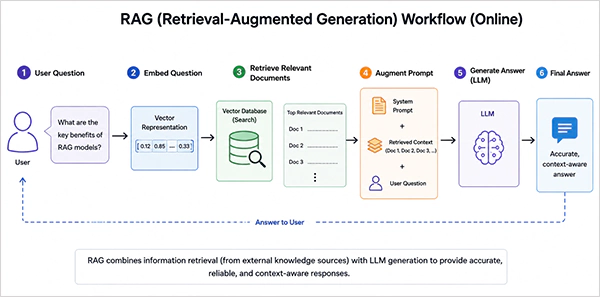
The retrieval- augmented generation works by searching external sources for relevant information about the topic. Then it formulates the answer to the question.
Here is how it actually works.
After everything is settled and the user is given an answer, the external data and embeddings are updated regularly. In some cases, updating in real-time is not possible, so they schedule the system to retrieve the latest information.
RAG pipeline is the step-by-step workflow that fetches the relevant data and gives it to the language model to generate a response.
Let’s check out the RAG pipeline steps.
The core components of RAG architecture are the retriever, embedding model, vector database, and so on.
Have a look.
| Method | What It Does | When to Use It | Data Needs | Cost |
| RAG | Adds external knowledge to LLM responses | For current or domain-specific answers | Knowledge base/documents | Medium |
| Fine-Tuning | Adapts a model for specific tasks | For specialized behavior or outputs | Curated training examples | Medium–High |
| Prompt Engineering | Improves outputs through better instructions | For quick, simple optimization | Minimal | Low |
| Pretraining | Builds a foundation model from scratch | When creating a new LLM | Massive datasets | Very High |
Note: These methods aren’t mutually exclusive. For example, a pretrained or fine-tuned model can also utilize RAG for an external knowledge base. In document-heavy workflows, retrieval quality can improve when scanned files are digitized through optical character recognition before indexing.
Also Read: What Is Data Extraction?
Both RAG and semantic search are closely related; however, they serve completely different purposes.
Semantic search is a retrieval technique that is used within the RAG model. We can say that semantic search is a small part of the retrieval-augmented generation.
Semantic search works by finding complete information based on the meaning and context of the query. It doesn’t just rely on matching exact keywords.
On the other hand, retrieval-augmented generation is a complete model that is used to retrieve data from external sources and provide context to LLMs.
The main difference between these two is retrieval vs. retrieval plus generation.
Yes, semantic search finds and returns relevant information, while RAG retrieves the relevant information and uses LLMs to generate a grounded answer based on that.
If we have to explain in simple words, we can say that semantic search can power one step of RAG–retrieval. So, it will never become an alternative to RAG.
RAG is the backbone of many LLM models available today. It is in high demand because of several benefits.
Have a look.
Well, RAG improves AI performance, but it also leads to some complexity as well.
Here is the list of challenges faced by RAG.
Also Read: What is Data Processing?
If you are an ardent AI user, you must have known about the issues that plagued most LLM models. To mitigate these issues, there are a few techniques or models. However, none can match the practicality and cost-effectiveness of retrieved augmented generation.
Now, it has evolved from just being a buzzword in the AI world to an indispensable foundation for AI. We can confidently say this because it can blend powerful LLM models with a knowledge base for current data.
RAG is a framework that connects LLMs to external sources for better grounding and accuracy.
RAG in AI stands for Retrieval-Augmented Generation.
No, they are not the same thing. RAG adds external knowledge to LLM responses, while fine-tuning adapts a model for specific training.
Yes, RAG helps reduce hallucinations.
Sources:
AI and machine learning have stepped out of laboratories to be used in a multitude of everyday products. Some of…
September 14, 2026
When you see the padlock icon on your computer or visit a secure website, something immediately clicks within the invisible…
August 27, 2026
Markdown is a type of lightweight markup language that is used to represent plain text in a structured way. It…
August 21, 2026
Retrieval-Augmented Generation (RAG) is an AI framework that connects LLMs to external data sources so they can give accurate and…
August 3, 2026
A data lake is a storage repository specifically designed to store large amounts of structured, semi-structured, and unstructured data in…
July 30, 2026
Every second, businesses generate massive amounts of data through customer interaction, SaaS applications, and cloud platforms. Collecting this data is…
July 27, 2026 By Jim Hartman