 By Jim Hartman
A data pipeline is an automated workflow that moves data from a source to the target system (data warehouses or data lakes).

Every second, businesses generate massive amounts of data through customer interaction, SaaS applications, and cloud platforms.
Collecting this data is not a challenge, but the task of connecting data with the systems and the people who need it is. When engineering teams manually parse this data, reports get delayed, and key initiatives fail.
That is where a data pipeline comes in.
At the moment data is generated, it relies on automated data pipelines to connect to all systems. Think of it as the circulatory system of any business. It continuously takes data from one system to another (like cloud warehouses, lakehouses, and more).
Read this guide to learn “what is a data pipeline,” its core components, benefits, types, and more.
A data pipeline is an automated workflow that moves data from one or more source systems to a destination where it can be stored, processed, or analyzed.
It eliminates the need for manual data extraction. The main purpose of a pipeline is to move the information from one system to another with security and consistency.
Most of these pipelines include validation capabilities that ensure the data entering the system is accurate and high-quality.
Typically, a pipeline operates in one of two ways:
Data pipelines are a broader term. In simple terms, data pipelines refer to the collection of automated workflows a company uses to move and process data.
It simply means that businesses use more than one pipeline to support their business functions.
For example, a business may use the following:
Each pipeline will serve a different function, data source, transformation logic, and destination.
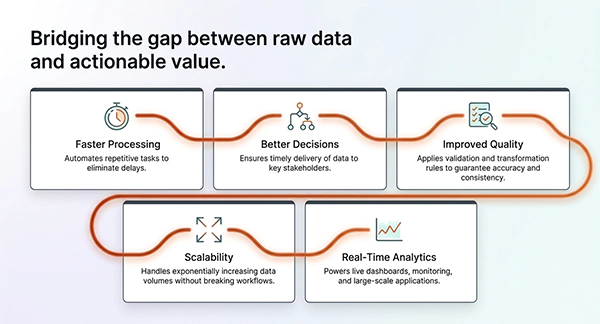
Data pipelines are crucial because they bridge the gap between raw data and actionable value for a business. Without pipelines, engineers are required to manually extract and clean the data, taking countless hours.
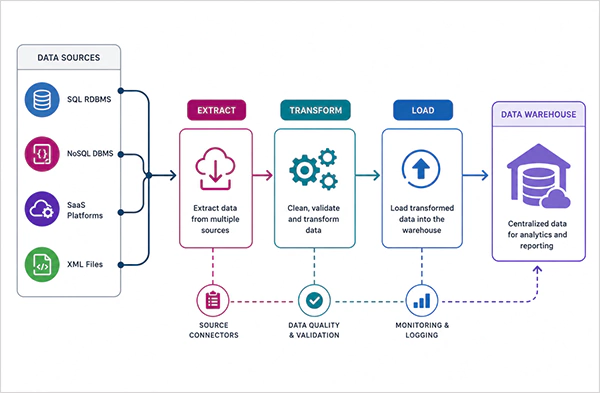
In a pipeline, source systems have different methods of processing raw data than target systems.
Data pipeline software automates the process of extracting data from various sources. Its job also includes transforming, combining, and validating that data for target systems.
1. Data Collection from Various Sources
A data source can be anything from an application, a device, or another database. The pipeline may extract the data using an API call or a data duplication process.
2. Data Transformation
When raw data flows through the pipeline, it becomes more useful for business intelligence. Throughout the process, the data is cleaned, validated, and filtered.
3. Data Storage
At the end of the pipeline lies a data warehouse or data lake where it is stored for further use in business. It can also be called a data sink.
4. Data Consumption
Once the data is stored and processed, it is ready to be consumed by users and analysts. Various applications also use this processed data.
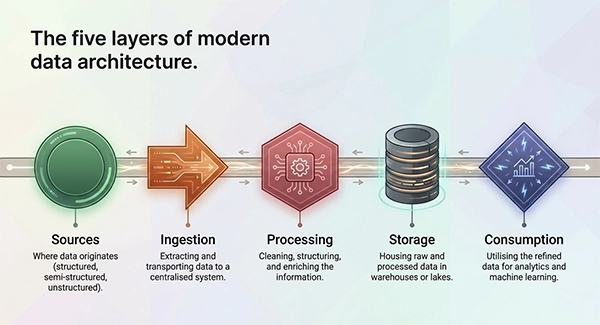
A modern data pipeline consists of five core components:
Here is a quick breakdown of how essential layers work together in a pipeline.
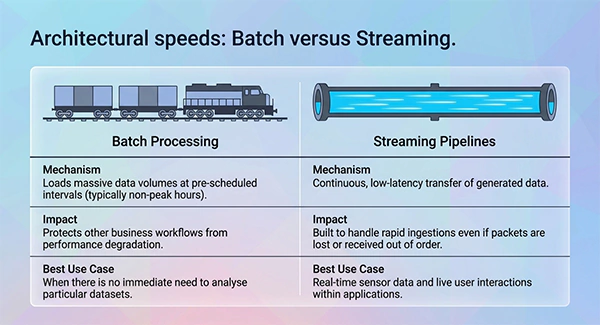
Not every data pipeline works the same way. How fast data is traveling or how it’s processed depends on the selected architecture.
There are two main types of pipelines:
Let’s check them out in detail.
This type of pipeline processes and stores data in large volumes or batches. It is suitable for tasks that require a high volume of data but not immediate accounting.
As the name suggests, batch processing loads the data into the target system at set intervals. Typically, in non-peak hours of business. Due to this, other workflows of the business are not impacted since batch processing deals with a large amount of data.
Note: It is the most effective data pipeline method where there is no immediate need to analyze particular data.
Unlike batch processing, streaming pipelines continue the transfer of data generated by various sources. It is specifically useful for things like sensors or user interactions within an application.
This type of data pipeline requires low latency. It means the pipeline should be able to handle it even if some packets are lost or received in the wrong order.
It is another way to categorize data pipelines when the actual transformation happens.
Extract, Transform, Load (ETL): This is a traditional approach to handling data. It means the data is extracted from the source, transformed in the middle, and then sent to the target.
Extract, Load, Transform (ELT): This is slightly different than ETL; here, raw data is extracted and sent directly to the target system. The transformation of the data happens after it reaches the destination.
Building a data pipeline might look easy, but building one that scales and works to correct itself comes with its own set of challenges.
These practices will help you design efficient pipelines.
Data pipelines are widely used in various industries that serve many purposes.
Have a look at the common pipeline use cases.
Big e-commerce platforms like Amazon and eBay gather information about customer interactions that include their purchase history, reviews, and product views.
After gathering all that data, they feed it to a special algorithm for analysis and generating insights. Ultimately, it will power the personalized marketing campaigns and product recommendations on these platforms.
Top social media platforms like Facebook and Instagram also leverage data pipelines to collect and analyze user interaction data. This analysis powers their high-performing and secret algorithm to deliver targeted content and advertisements.
Yes, data pipelines are also used in the healthcare industry. Real-time patient monitoring in the ICU, fetching unified health records, and more can be done in the healthcare sector.
Banks and various financial institutions rely on pipelines for fraud detection by processing millions of credit card transactions in real time. ML models also work in tandem to flag anomalies.
DataQix’s data extraction services are widely known in the industry. We possess expertise in designing and maintaining pipelines through various services.
Our services include:
Are you ready to upgrade your data infrastructure? Contact our experts to help you design a highly scalable and real-time pipeline for your business workflow.
A data pipeline is an automated workflow that moves data from a source to the target system (data warehouses or data lakes).
Data pipelines in various companies are used to clean, transform, and integrate data so businesses can use it easily for analytics and more.
A data pipeline works by extracting the data from a source, then transforming it in the middle tier, and finally sending it to the target system.
The data pipeline architecture is the structured blueprint for collecting, processing, and transforming data received from various sources for storage.
Sources:
AI and machine learning have stepped out of laboratories to be used in a multitude of everyday products. Some of…
September 14, 2026
When you see the padlock icon on your computer or visit a secure website, something immediately clicks within the invisible…
August 27, 2026
Markdown is a type of lightweight markup language that is used to represent plain text in a structured way. It…
August 21, 2026
Retrieval-Augmented Generation (RAG) is an AI framework that connects LLMs to external data sources so they can give accurate and…
August 3, 2026
A data lake is a storage repository specifically designed to store large amounts of structured, semi-structured, and unstructured data in…
July 30, 2026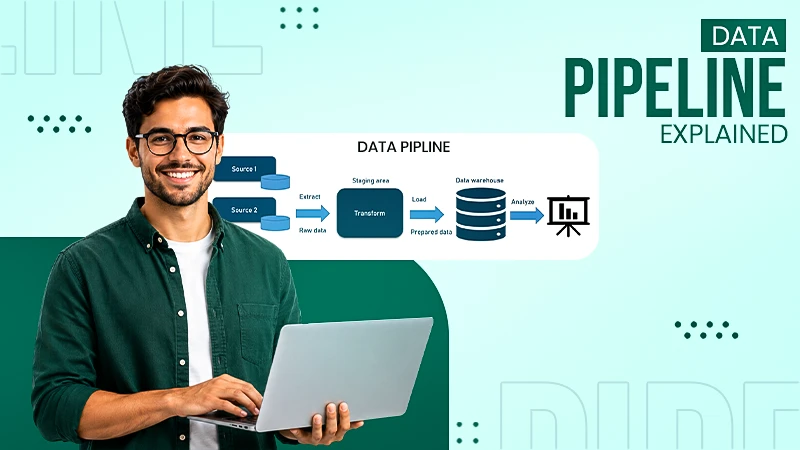
Every second, businesses generate massive amounts of data through customer interaction, SaaS applications, and cloud platforms. Collecting this data is…
July 27, 2026 By Tina Brown