 By Tina Brown
Data annotation is the activity of tagging or labeling raw data, including images, texts, sounds, and videos, so that AI programs can understand them and learn from them.


AI and machine learning have stepped out of laboratories to be used in a multitude of everyday products. Some of these products include recommendation engines, voice assistants, self-driving cars, and fraud detection systems. At the core of the aforementioned systems is the machine learning model that learns to identify patterns in data to make predictions.
Nevertheless, the models cannot learn on their own. They need a vast array of examples to understand what the “correct” answer is according to the input provided to them. Therefore, the quality of the training data becomes a vital issue. The model will be as good as the data it uses for learning purposes. If the data is unorganized, inconsistent, or incorrectly labeled, then the model will yield messy and unacceptable results regardless of how advanced the algorithm might be. However, when clean and accurately labeled data is provided, the model will be successful even if it is based on a simple architecture. In other words, the quality of data plays a major role in the functioning of an artificial intelligence system.
We will discuss what is data annotation, types of data annotation, the whole process of annotation, tools that are commonly used, as well as examples that will help to understand how annotated data facilitates machine learning. Organizations may also use data processing services to prepare and organize large volumes of information before or alongside annotation.
Data annotation refers to attaching relevant information to raw data so that AI technology or a machine learning model can interpret it correctly. Simply put, data annotation refers to the process of telling a machine about the evidence of a given data and its interpretation.
Raw data may constitute various forms of information such as text, image, audio, or video. In its original form, this data might not have enough context and meaning for the machine learning model to extract the right patterns. Using the data annotation process, specific parts of the data receive specific labels that add context. Here are the steps performed for data annotations
Moving from Raw Data to Labeled Data
Step 1: Gather raw input – that includes the pictures, text files, sounds, videos, and other types of content.
Step 2: Give it descriptions – specialists, either human annotators or AI systems, mark it with appropriate labels, tags, boundaries, and/or transcription so that it can be described.
Step 3: Structure the output – format the labeled data, making it readable by software for the machine learning process (e.g., JSON, XML, CSV).
Step 4: Train the machine – the model will analyze those labeled samples during training.
For instance, if we have a letter from a customer to the support team regarding a problem with payment, we can mark it with a label referring to “payment issues”.
To summarize, data annotation links raw data to machine learning, enabling models to learn from structured examples and perform tasks such as recognizing patterns, categorizing data, and forecasting. In some workflows, organizations also use data extraction services to obtain the raw information that will later be organized and annotated.
Why Labeled Data Matters
Labeled data is valuable because most AI systems use supervised learning, meaning models learn by comparing their predictions with what they are expected to see.
The quality of the information used in the labels is of utmost importance, as bad labeling can result in the machine learning model receiving negative patterns.
Note that almost all modern AI technologies depend on supervised learning, the process in which the model’s output is evaluated by comparing it to the labeled data.
Data annotation plays a crucial role in the development of AI and ML models as it allows machines to learn from distinctive examples. Here are a few examples of its advantages
Accurate input is especially important because organizations need effective data quality management practices throughout the data lifecycle.
Several types of data annotations are given below.
Image annotation consists of assigning labels to specific objects and areas of a picture, enabling machines to be aware of visual information. The most common ways of image annotation are:
Text annotation is a process of labeling a piece of text to enable AI systems to comprehend language. It can be categorized into the following types:
Video annotation assigns tags to movements, objects, and happenings taking place in the various frames of the video. The most important types of video annotation are:
Audio annotation includes tagging the speech or sound in order to help Algorithms to identify the audio. The main types of audio annotation are:
LiDAR and 3D annotation include labeling different objects and points in the three-dimensional data. This is useful in developing AI used in space and robotics and in designing autonomous cars.
The process of data annotation for an AI model with LLM and generative AI improves this model’s output in terms of quality, safety, and usability.
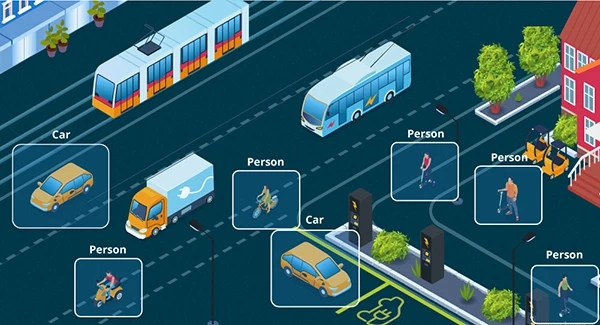
The process of data annotation can be divided into several stages.
Depending on the source and destination formats, organizations may also use data conversion services to prepare information for use across different systems.
The process of data annotation is unique for each type of data that needs to be labeled. Here are a few instances of different types of data annotation:
Images: Draw rectangles surrounding the various objects, such as cars and people, to enable an AI system to identify different objects.
Text: Determine if a customer’s review is positive or negative for sentiment analysis.
Audio: Convert spoken dialog into written text so that speech recognition systems can use it.
Video: Monitor the movements of an object throughout several frames to help the AI recognize its movement.
When large volumes of source information need to be prepared before annotation, data extraction can help bring relevant information together from different sources.
The role of a data annotator involves labeling so that the data can be used to help train artificial intelligence and machine learning systems. The responsibilities of a data annotator are as follows:
Labeling of data: Adding the right labels to different kinds of data such as images, text, video, as well as audio.
Abiding by rules of annotation: Following the specific rules and instructions laid down for any project.
Review and rectify mistakes: Finding out the errors in annotations and correcting them.
Preserving excellence and uniformity: Ensuring that annotations conform to the requisite level of accuracy and quality across the dataset.
For projects that involve repetitive digital tasks alongside annotation, outsourcing data entry can help organizations manage high-volume workloads.
Data annotation technology consists of software and platforms that streamline the process of labeling, reviewing, and managing the datasets. These tools are used in projects such as image, text, audio, video, 3D, and AI annotation.
Data annotation software facilitates the process of labeling different kinds of data by annotators, depending on the project they have. Some significant software features are bounding boxes, text tagging, transcription, segmentation, and classification, depending on the specific project.
Common features are:
For repetitive labeling and information-handling workflows, data entry automation can also reduce manual effort and improve processing efficiency.
A data annotation platform provides a broader environment for data annotation since it includes the process of managing large-scale data annotation projects.
Common features are
The key features of annotation platforms involve:
To be precise, annotation technology refers to equipment that produces annotated data, while annotation platforms encompass the management of tasks, processes, teams, and data sets.
Careful data annotation can lead to significant benefits during the different stages of creating the AI system. Check the important advantages below.
Data that has been properly annotated makes it possible for the model to learn the correct ways of performing its functions. The model trained with properly annotated data will make fewer mistakes in its operations.
An efficient delivery of very clear instructions to those doing the work, assuring consistency and establishing quality checks, will result in data sets that are clean, consistent, and reflective of real conditions around us.
If the annotated data is well-organized, labeled consistently, and delivered in a ready format for a model to be created, the machine learning teams would spend less time cleaning and correcting the data and more time on building and training their models.
As the annotation tools enter the era of AI-supported pre-labeling, the annotation process itself is becoming faster and requires less human effort, allowing annotators to focus on reviewing and correcting the results rather than creating the data themselves. Automation can also be applied to broader data workflows through data automation, helping organizations reduce repetitive manual processes.
Data annotation is crucial to recognize and categorize objects. Computer vision uses picture and video inputs, while natural language processing requires labeled texts to process languages, emotions, and meanings. Similarly, generative artificial intelligence is based on input data in order to create useful results.
Data annotation is a vital part of AI technologies, but it does have some drawbacks too.
Data annotation is actually one of the longest-lasting kinds of work in AI development. Labeling the data is a costly process because the work requires human effort from people involved in the work on either side – whether it is the company’s employees or special service providers.
Modern machine learning models need huge volumes of labeled data to function correctly. Doing the annotation of datasets of such sizes is indeed a challenge, as it becomes much more complicated to manage the work with a higher number of labeled samples.
Annotators might commit errors, resulting in incorrect training data.
Several annotators may view similar data in different ways, leading to inconsistency in datasets.
It is critical to ensure the protection of confidential data.
As projects and teams grow, it is challenging to achieve uniformity and precision in the annotations.
Following effective practices of annotation ensures correctness and consistency of data sets used for artificial intelligence machinery.
Even though they are often used interchangeably, there is a small difference between the two terms.
The term data labeling usually refers to a simpler process of tagging or categorizing data. For example, labeling an image as “cat” or classifying the review as “good” can be called data labeling.
Data annotation is a more general term used to describe not only the act of labeling but also other types of data marking. Data annotation refers to more complex actions such as creating bounding boxes, segmentation masks, keypoint marking, and even audio transcription with timestamps included.
Data annotation and data labeling can both be considered terms used to refer to the act of processing raw data by converting it into useful labeled datasets. However, the two are different, as data annotation includes more detailed notes, tags, or metadata, while data labeling merely consists of providing labels/categories to the sample.
| Data Annotation | Data Labeling |
| Can include specification details like markings, titles, or metadata | Usually includes labeling or categorizing |
| Includes activities like segmenting, bounding box, and key points | Involves work like classification and sentiment label |
| It normally gives more information about the data | Focuses instead on identifying the correct class or category |
| Is meant to prepare the organized training data for AI systems | Is meant to create the labeled datasets for machine learning |
Although there is a slight difference between the two terms, data experts in most cases use them as synonyms, using the term labeling as a general one for all kinds of annotation, including segmentation.
Data annotation is important because it makes it possible to create accurate and reliable AI or machine learning models. Through accurate data annotation, the data is capable of being converted into well-annotated datasets that can be learned by the system and allow it to achieve good results in real life.
As advancements continue to be made in AI technology, the demand for high-quality annotated data will remain relevant to many applications, whether they are related to computer vision, the field of Natural Language Processing, or generative AI itself. Through proper guiding principles and quality control, companies have a better chance of producing better training sets that would serve reliable AI systems.
Trying to enhance your AI system by using high-quality data sets?
Take a look at professional data annotation services for assistance.
Data annotation is the activity of tagging or labeling raw data, including images, texts, sounds, and videos, so that AI programs can understand them and learn from them.
Data annotation provides AI systems with the necessary labeled samples of data that enable them to identify patterns and thus achieve efficient results.
These include several classes, such as digital data annotation, ranging from video and audio content to computer vision data, depending on the different Artificial Intelligence processes and data types involved.
They have to annotate the data as per the standards given for the project/tasks. They have to check those annotations continuously, make corrections, and ensure standardization and quality of the data.
The terms are often used interchangeably. Whereas the term ‘data labeling’ only implies mere categorization or tagging of the data, while annotation stands for automated fixes and computer vision data annotation that includes data bounding boxes, etc.
Some of the common obstacles in data annotation are associated with high costs, time-consuming processes, relatively big datasets, errors made by the human, etc.
AI and machine learning have stepped out of laboratories to be used in a multitude of everyday products. Some of…
September 14, 2026
When you see the padlock icon on your computer or visit a secure website, something immediately clicks within the invisible…
August 27, 2026
Markdown is a type of lightweight markup language that is used to represent plain text in a structured way. It…
August 21, 2026
Retrieval-Augmented Generation (RAG) is an AI framework that connects LLMs to external data sources so they can give accurate and…
August 3, 2026
A data lake is a storage repository specifically designed to store large amounts of structured, semi-structured, and unstructured data in…
July 30, 2026
Every second, businesses generate massive amounts of data through customer interaction, SaaS applications, and cloud platforms. Collecting this data is…
July 27, 2026 By Jim Hartman